Frappe PMM

Sales Procedure


On this page
Last updated on 24th March, 2026
Sales Procedures
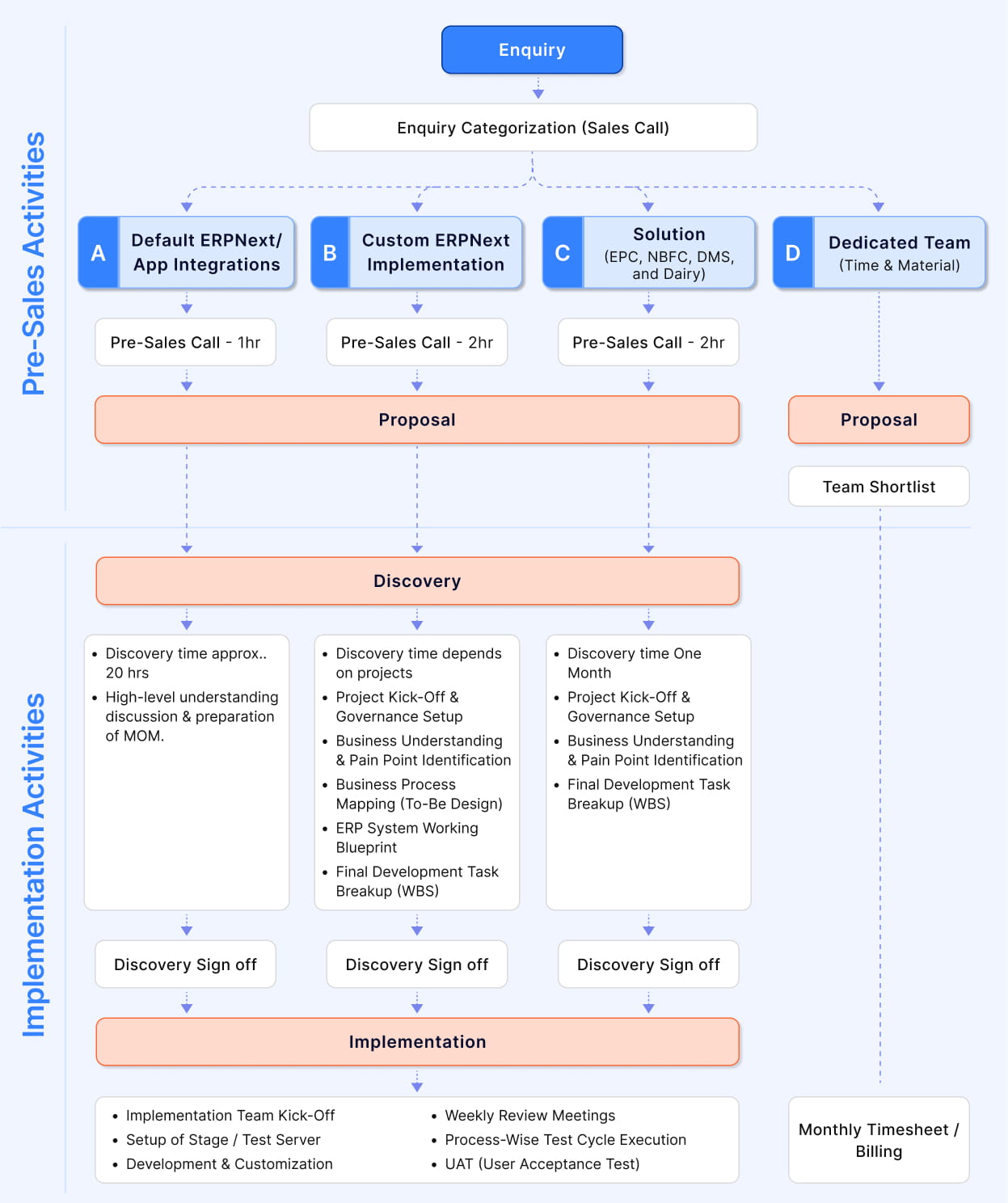
Purpose
- Establish a structured approach for managing customer enquiries with clarity and accountability.
- Ensure businesses receive the right guidance by understanding their challenges before proposing solutions.
- Enable a smooth and confident transition from initial discussion to successful project engagement.
Tools Used
The following tools are utilised to ensure structured opportunity tracking, efficient communication, and accurate solution estimation:
Frappe CRM
- Used for managing enquiries, tracking customer interactions, and monitoring the complete opportunity lifecycle.
In-House Estimation Tool
- A client-facing tool on our website where businesses can submit their requirements and generate a basic ERPNext feature list within about 30 minutes.
- Our consulting team then reviews the details and prepares the final effort and cost estimation if additional customization is required.
Tool Demo:
AI-Assisted Estimation Support
- We also leverage AI-tools (e.g., ChatGPT, Cluade,Perplexity) to support requirement analysis, estimation validation, and preparation of structured solution approaches.
Training & Enablement
From the time of onboarding, every team member undergoes a structured 12-week sales training program to understand the complete opportunity lifecycle, ERPNext solutions, and client engagement processes.
The training is designed to help team members develop skills in lead qualification, client communication, solution positioning, and proposal preparation while following the organisation’s defined sales processes.
3-Month Training Roadmap at a Glance
WEEK 1
Foundation & Product Knowledge
Understand ERPNext modules, Sanskar offerings, and internal tools to be client-ready from Day 2
WEEKS 2–6
Lead Generation & Client Outreach
Build and qualify a lead pipeline; conduct outreach campaigns and first discovery calls
WEEKS 7–12
Sales Execution & Proposals
Handle client communication independently and deliver winning proposals and case studies
Month
Focus Area
Duration
Key Outcomes
Focus Area
Foundation + Lead Generation Launch
Duration
Week 1 + Weeks 2–4
Key Outcomes
ERPNext literacy & first outreach campaigns live
Focus Area
Outreach, Discovery & Client Comm.
Duration
Weeks 5–8
Key Outcomes
Active pipeline, discovery calls, and client follow-ups
Focus Area
Sales Execution, Proposals & Review
Duration
Weeks 9–12
Key Outcomes
Proposals submitted, demos conducted, final KPI review
Sales Procedure
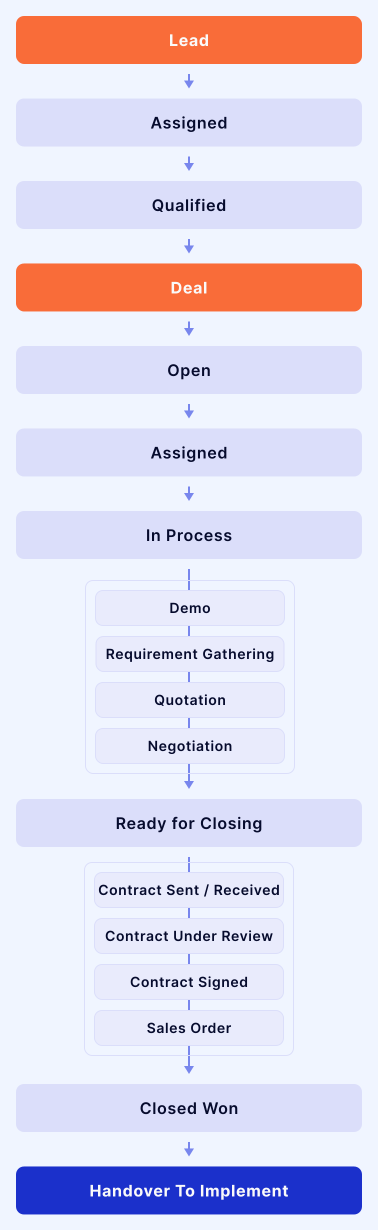
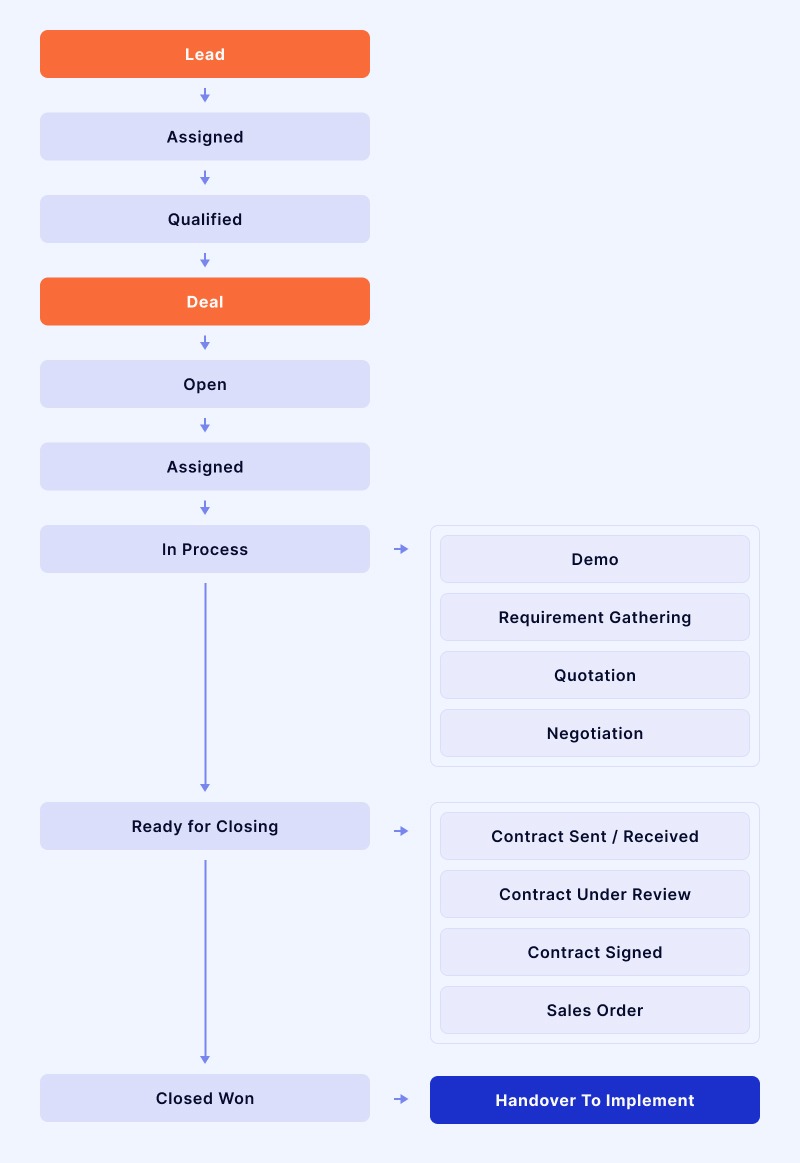
Lead
Initial enquiry received from potential customers through different channels.
Key Activities:
- Lead captured via website, reference, campaigns or direct contact
- Lead created in CRM
- Basic customer details recorded
- Initial acknowledgement sent
Assigned
Lead ownership is assigned to a responsible sales representative.
Key Activities:
- Lead assigned to sales owner
- Responsibility defined
- First customer interaction planned
- SLA response initiated
Qualified
Lead is evaluated to determine whether it is a valid opportunity.
Key Activities:
- BANT qualification performed (Budget, Authority, Need, Timeline)
- Qualification discussion documented in CRM
Deal
Qualified leads are converted into active sales opportunities.
Key Activities:
- Opportunity created in system
- Initial scope discussion started
- Expected deal value identified
- Sales tracking begins
Demo
Product demonstration conducted based on business requirements.
Key Activities:
- Business-focused ERPNext demo
- Use-case explanation
- Customer queries addressed
- Demo feedback captured
Requirement Gathering
Detailed business understanding and analysis is performed.
Key Activities:
- Current workflow analysis
- Gap identification
- Customization discussion
- Expected outcomes defined
Quotation
Proposal or quotation prepared based on agreed scope.
Key Activities:
- Scope finalization
- Effort estimation
- Costing preparation
- Proposal shared with customer
Negotiation
Commercial and scope discussions finalized before agreement.
Key Activities:
- Pricing discussion
- Scope clarification
- Requirement adjustments
- Alignment on expectations
Follow Up
Continuous communication maintained to progress the opportunity.
Key Activities:
- Customer follow-ups
- Query resolution
- Decision support
Ready for Closing
Opportunity prepared for final decision and agreement.
Key Activities:
- Final scope confirmation
- Commercial alignment
- Contract preparation initiated
Contract Sent / Received
Agreement exchanged with customer for formal engagement.
Key Activities:
- Contract shared with customer
- Terms review
- Contract received for confirmation
Contract Under Review
Agreement reviewed by both parties before signing.
Key Activities:
- Contract terms verification
- Clarifications discussed
- Final approval preparation
Contract Signed
Formal agreement confirming project engagement.
Key Activities:
- Signed contract received
- Engagement confirmed
- Project preparation started
Sales Order
Commercial confirmation recorded in the system.
Key Activities:
- Sales order created in ERPNext
- Payment terms confirmed
- Internal project approval initiated
Closed Won
Opportunity officially marked as successful.
Key Activities:
- Deal marked as won
- Customer onboarding confirmation
- Project kickoff planning
Handover to Implementation
Project transferred to delivery team for execution.
Key Activities:
- Complete project handover
- Scope and documentation shared
- Implementation team engaged


