ERPNext case study
From Legacy ERP to a Future-Ready Distributor Management ERP Software
Transforming Operations with Wholesale Distributor ERP Software for Multi-Location, Multi-Brand Distributor
Client Overview
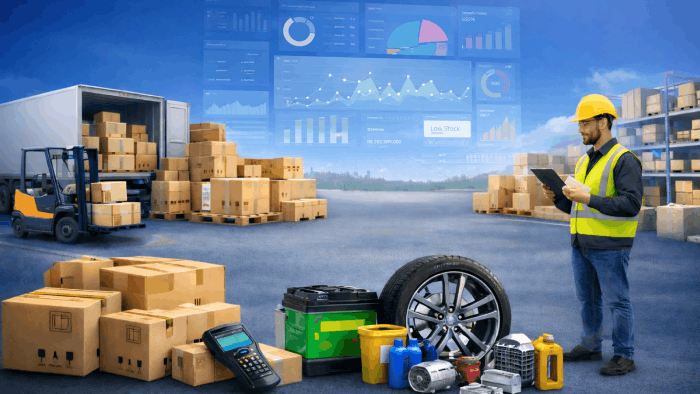
Amritlal Desai & Co., founded in 1937, is a Bhuj-based business operating in automobile batteries, heavy machinery, spare parts, and service segments. The company has an annual turnover of approximately ₹70 crore and operates across four branches in Kutch.
21,000+Items listed in ERP
11,000+Registered customers
300+Active suppliers & vendors
2,000+Monthly invoices generated
Brand Dealerships








Bhuj,India.
Industry
Automotive & Industrial Equipment Trading Business
Apps implemented

ERPNext

Frappe HR

Framework
modules implemented
Manufacturing
Purchase
Sales
Quality Check
Accounts
Stock
Warehouse Management
What does the client want from us?
The Miracle ERP system supported Amritlal Desai & Co. well for many years. As the business expanded across multiple locations, added more products, and handled increased compliance requirements, the existing system began to show limitations in control, visibility, and process consistency.
Objectives of the ERP Transition

Move to a cleaner and structured ERP system

Maintain smooth day-to-day business operations

Ensure accuracy in financial and inventory data

Improve visibility and process control across branches

Avoid unnecessary complexity during the transition
To achieve this, a planned ERP implementation approach was followed instead of migrating the entire historical system.
Design Philosophy
The implementation followed a business-first approach:

Real workflows over standard ERP assumptions
Strong validations before automation
Clean operational starting point
Focus on long-term usability and control
ERPNext was positioned as a structured foundation for future operations, not just a system replacement.
Key Challenges in the Legacy Miracle ERP
System Performance & Scalability
Challenge
Over time, large data volumes and high transaction activity caused the system to slow down during billing, stock handling, and reporting.
Solution
Moved to ERPNext with a clean setup and well-structured master data, which improved system speed and allowed the system to scale with business growth.
Warranty Management
Challenge
Warranty replacements for batteries and similar products were handled manually, with no clear process for free or pro-rata replacements.
Solution
Built a system-driven warranty process in ERPNext to handle stock movement, returns, and billing with proper checks and controls.
Battery Charging & Reconditioning Tracking
Challenge
Battery charging, reconditioning, and movement were recorded in manual registers, leading to limited visibility and tracking issues.
Solution
Brought battery charging and reconditioning activities into ERPNext, enabling proper tracking of stock movement and real-time visibility.
Delivery & Dispatch Tracking
Challenge
Deliveries and vehicle-wise dispatches were not tracked in the system, making it hard to monitor delivery status and completion.
Solution
Introduced delivery and dispatch tracking in ERPNext, allowing vehicle-wise and trip-wise monitoring of material movement.
HR & Payroll Integration
Challenge
Attendance and payroll were managed outside the ERP, resulting in manual work and data mismatches.
Solution
Implemented ERP-based HR and payroll with face-recognition attendance and automated salary processing.
Key Business Implementations
Walking Customer & GST Compliance
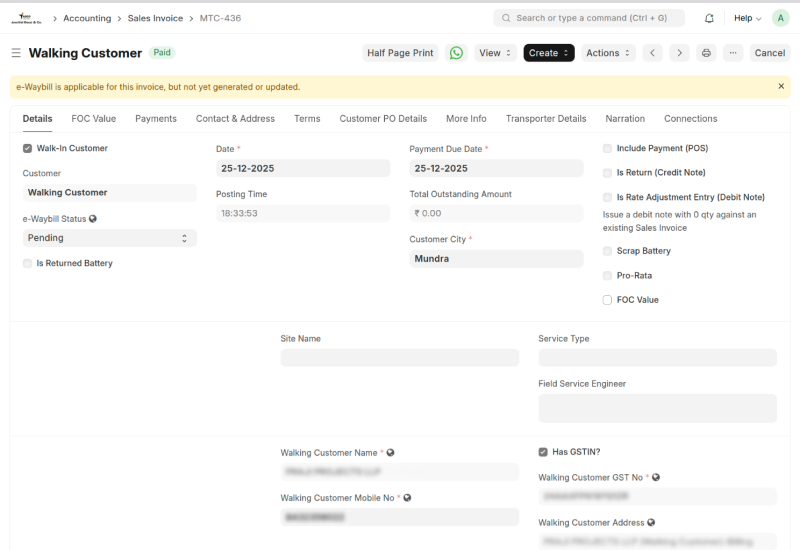
Introduced controlled billing rules for walk-in customers to ensure GST details are captured correctly at the time of invoicing.
Made GST address mandatory whenever a GSTIN is provided, preventing incomplete or non-compliant invoices.
Automated tax category and GST template application based on customer and transaction details.
Blocked invoice submission if mandatory GST information is missing.
Outcome:
GST compliance is enforced at the system level, resulting in clean and accurate GSTR-1 reporting without manual intervention.
Expense Booking Across Multiple Cost Centers
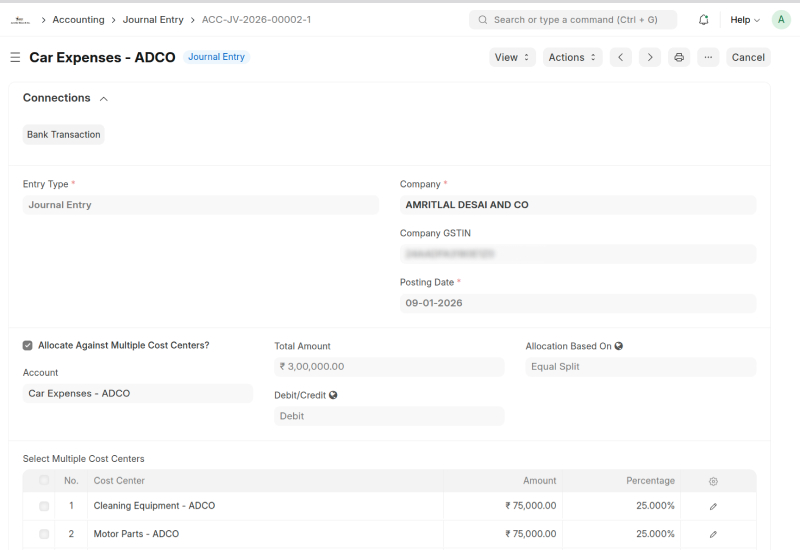
Enabled line-item-wise expense allocation, allowing a single expense document to be distributed across multiple cost centers.
Configured branch-wise and department-wise cost tracking to reflect actual expense ownership.
Ensured expense allocation flows correctly into financial reports.
Outcome:
Management gains clear visibility into expenses by branch and department, leading to more accurate Profit & Loss reporting and improved cost control.
Inventory Control with Serial & Batch Tracking
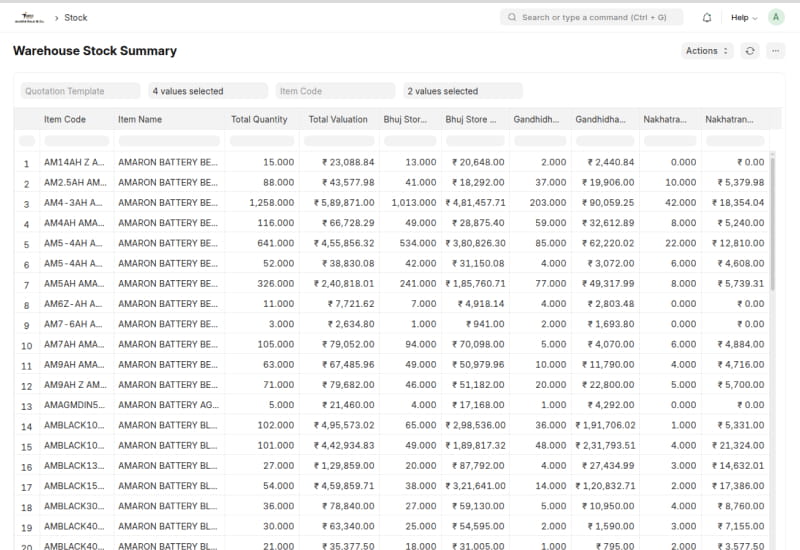
Implemented serial number and batch number tracking for high-value and warranty-driven items.
Enabled barcode and QR code scanning to speed up transactions and reduce manual errors.
Configured warehouse-wise serial availability to prevent incorrect stock usage.
Developed serial and batch history tracking for audit and warranty reference.
Outcome:
End-to-end inventory traceability is achieved, reducing stock discrepancies and simplifying audits.
Warranty Replacement Automation (FOC & Pro-Rata)
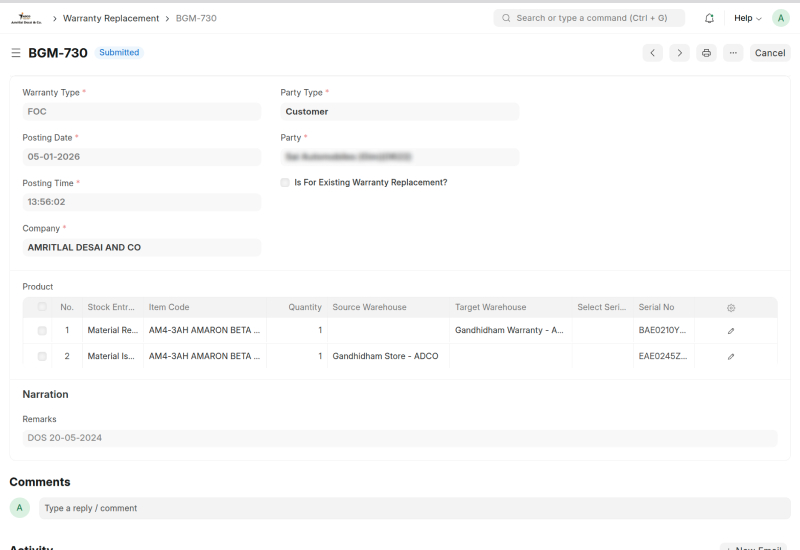
Designed a dedicated warranty replacement process aligned with real business scenarios.
Automated the creation of stock entries, sales returns, and new invoices for both free-of-cost and pro-rata warranty cases.
Applied strict validations for serial numbers, quantities, and warehouse selection to avoid errors.
Outcome:
Warranty handling is fully system-driven, ensuring accurate stock movement and financial impact without manual follow-ups.
Accounting Accuracy & Financial Control
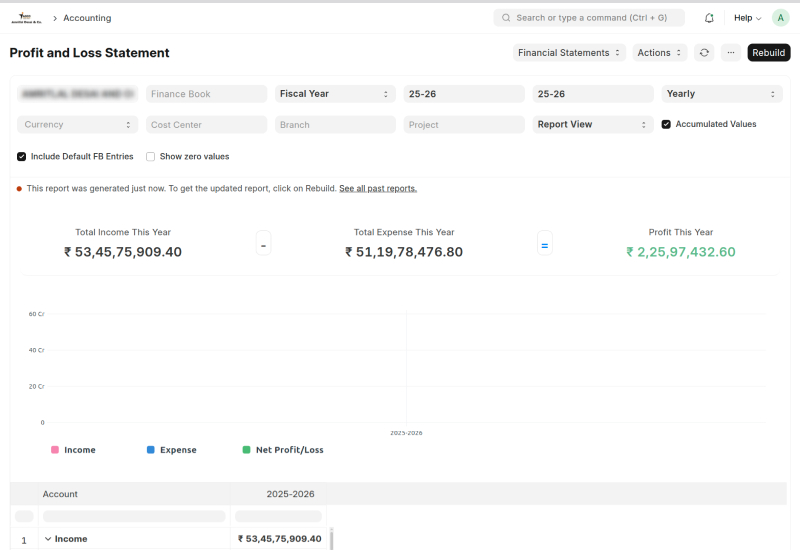
Implemented branch-wise accounting to support multi-location operations.
Configured item group–wise cost center mapping, ensuring sales and purchase transactions automatically post to the correct cost centers.
Ensured service items and spare parts reflect correct departmental profitability.
Introduced posting controls and period-closing discipline to prevent incorrect or backdated entries.
Outcome:
Financial statements such as Trial Balance, Profit & Loss, and Balance Sheet are reliable, consistent, and aligned with actual business performance.
Face Recognition–Based Attendance & Access Control

Implemented face recognition for employee attendance to replace manual punching.
Automated check-in and check-out based on face scans.
Linked attendance data directly with payroll processing.
Reduced dependency on manual attendance registers and corrections.
Outcome:
Attendance tracking became accurate, tamper-resistant, and fully integrated with payroll, improving HR efficiency and data reliability.
Sanskar Technolab's Role
Sanskar Technolab was responsible for the end-to-end ERPNext implementation, including:

Business process study and system design

ERPNext configuration aligned with real workflows

Selective and controlled data migration

Custom development for business-critical flows

Validation of stock and financial accuracy

Go-live support and post-implementation stabilization
The focus remained on stability, control, and long-term usability.
Ready to Transform Your Operations With a Powerful Sanskar ERP?
Related Case Studies

Distribution Management Software
ERPNext
Beverage Distribution
Transforming Beverage Distribution with an All-in-one Distribution Management System

14 min read

Food Distribution ERP Software
ERPNext
Food Distribution
FMCG
Redefining FMCG Distribution in Dubai
Empowering a Leading Dubai FMCG Brand with Complete ERPNext Workflow Automation
9 min read

Loyalty Program Software
ERPNext
Loyalty
Digital Transformation in Tile Adhesives and Construction Chemicals with ERPNext
Dekaa is Building Tile Installers Loyalty with Every Bag of Adhesive
9 min read


