SAP S/4HANA Alternatives: 7 Options for Companies Still on SAP ECC
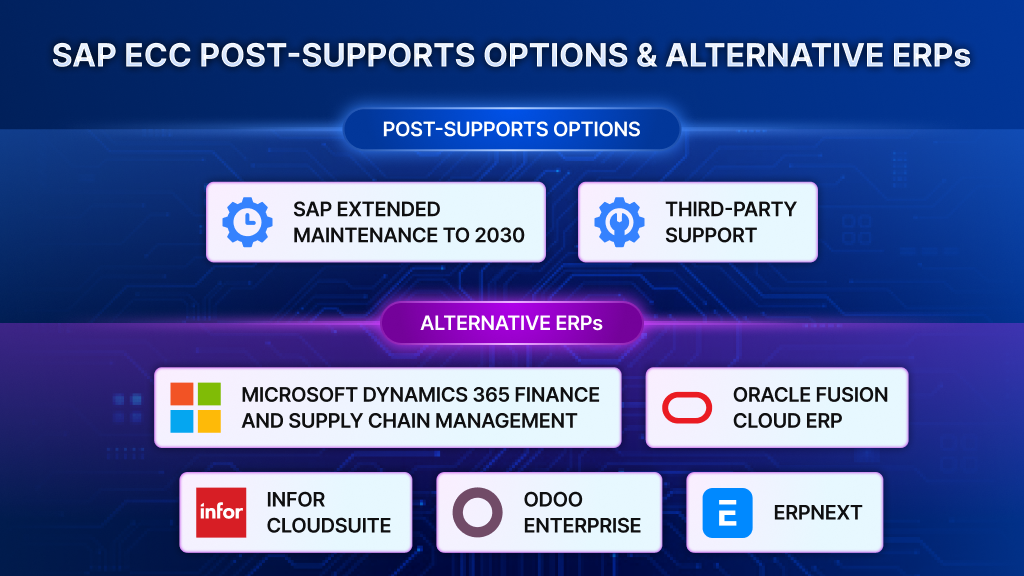
S/4HANA is SAP’s answer to the ECC deadline. It is not the only one. Here are two ways to stay on ECC longer and five ERPs that can replace it, judged on control, scale and stability before cost.

In November 2025, the group that owns B&Q and Screwfix said no to S/4HANA. Kingfisher, with £13 billion in turnover, asked SAP to show the business value of the upgrade, was not persuaded, and is moving its ECC system to Google Cloud with third-party support from Rimini Street.
Kingfisher is unusual in saying so publicly. It is not unusual in doubting. In a 2025 survey of 455 SAP customers commissioned by Rimini Street, 95% said building a business case for S/4HANA was difficult or took significant effort, and nearly a quarter planned to stay on on-premises ECC.
This guide is for CIOs and IT heads who want to see the whole field before they commit. It covers seven options. One caution first: Gartner's view is that only a minority of SAP customers are considering another ERP vendor. Leaving SAP is a real option, but it is not the default, and this guide says where it is the wrong one.
A disclosure too. We are Sanskar Technolab, an ERPNext implementation partner, and ERPNext is the seventh option. We have described the other six as fairly as we can, with sources.
The short answer

Two options keep you on ECC: SAP's extended maintenance to 2030, and third-party support, which Rimini Street offers to 2040. Both buy time. Neither is a destination.
Three are proprietary cloud suites: Microsoft Dynamics 365, Oracle Fusion Cloud ERP and Infor CloudSuite. All are proven at enterprise scale. With each, you exchange SAP's roadmap, update calendar and per-user pricing for another vendor's.
Two of them are based on open source software: Odoo Enterprise (open core software), and ERPNext (open source software with no license or per user fees).
Choose on control before cost. The questions that separate these options are who can change your workflows, who holds your database, and what evidence there is at your scale.
Six questions to judge any alternative
Companies that run SAP are rarely short of budget. When they talk to us about leaving, cost comes third or fourth. These six questions come first, and they are the ones this guide uses to compare the options.
1
Customisation.
Can you build your own workflows, or only configure the vendor's?
2
Flexibility.
Can your own team change them next quarter, without a change request to a vendor or partner?
3
Database control.
Who operates the database, and can you query and move your own data?
4
Data volume.
Is there evidence it carries years of history at your size?
5
Transaction load.
Does it hold up at month-end and in peak season?
6
Stability.
If it fails, what happens to your operations, and who decides when it changes?
Options 1 and 2: stay on ECC for longer
1. SAP extended maintenance to 2030
Mainstream maintenance for ECC 6.0 ends on 31 December 2027. SAP will keep legal changes and security patches coming until the end of 2030 for a premium of two percentage points on your maintenance rate. You must be on enhancement package 6, 7 or 8, and you must opt in.
Best for: a company that has chosen its next system and needs the time to get there. It solves nothing by itself. Our guide to every SAP ECC deadline covers the conditions, including what SAP added in October 2026 about third-party databases.
2. Third-party support
Firms such as Rimini Street and Spinnaker Support maintain ECC independently of SAP. Rimini Street has committed to supporting ECC 6.0 through 2040 and says clients save up to 50% on annual support fees. This is the route Kingfisher took.
You keep a system your people know, on customisations you have already paid for. You give up SAP's own notes and new software. A board member of the German-speaking SAP user group has warned that one consequence of third-party support is that SAP will not grant you any incentives, and a Gartner analyst commenting on Kingfisher put the limit plainly: eventually the core has to be upgraded.
Best for: a stable ECC system that the business is content with, where the freed budget will fund work outside the ERP. It postpones the platform decision without making it.
The five replacement ERPs compared
The other five options replace ECC. This table sets them against the first three questions, plus the two that follow from them: how updates reach you, and how you pay.
ERP
Customisation
Database and hosting
Updates
Pricing basis
ERP
Microsoft Dynamics 365 Finance and Supply Chain
Customisation
Extensions only. Microsoft states that overlayering is not supported
Database and hosting
Microsoft's cloud on Azure, with the database operated by Microsoft. An on-premises option keeps core data in your data centre
Updates
Four service updates a year. At least two must be taken
Pricing basis
Per user. List price $210 a month for a full Finance and Supply Chain user
ERP
Oracle Fusion Cloud ERP
Customisation
Configuration and extensions. Oracle limits modification of its underlying applications, middleware and database objects
Database and hosting
Software as a service only, in Oracle's cloud
Updates
Quarterly, for every customer
Pricing basis
Per user, per module. Estimated $375 to $475 a month for a full Financials user before discount
ERP
Infor CloudSuite
Customisation
Pre-built industry workflows. Reviewers report limits on customisation in the multi-tenant editions
Database and hosting
Multi-tenant on AWS. Single-tenant private cloud for regulated industries
Updates
Delivered by Infor in the multi-tenant cloud
Pricing basis
Per user. Market range about $150 to $400 a month
ERP
Odoo Enterprise
Customisation
Custom modules in Python, plus a no-code Studio. Custom code makes upgrades larger
Database and hosting
PostgreSQL. Odoo's own cloud, or your own servers on the Custom plan
Updates
A new main version each year. Plan an upgrade project every two to three years
Pricing basis
Per user. About €20 to €57 a month depending on plan and billing (Belgian list prices)
ERP
ERPNext
Customisation
Full source code. Custom apps in Python and JavaScript on the Frappe Framework
Database and hosting
MariaDB. Frappe Cloud, your own cloud account or your own data centre
Updates
You choose when. No licence fee to upgrade
Pricing basis
No licence fee and no per-user fee. You pay for implementation, hosting and support
Want this comparison against your own ECC landscape?
Send us your modules and custom object count. We will return a fit-gap for ERPNext and tell you where another option fits better.
Options 3 to 5: Dynamics 365, Oracle and Infor
These are the three that a board will consider. All of them are well-established products with a proven track record in big companies. Another thing they have in common with S/4HANA Cloud is that the code is owned by the supplier who also controls upgrades and sets prices for renewals.
3. Microsoft Dynamics 365 Finance and Supply Chain Management
This is Microsoft’s ERP system for big enterprises. It performs exceptionally well in financials and supply chain management and integrates nicely with Azure, Power BI, and Microsoft 365.
On customisation, Microsoft is explicit. Extensibility is the only customisation framework, and overlayering, which is direct modification of Microsoft's code, is not supported. You extend what Microsoft exposes, and where it does not expose what you need, you log an extensibility request. Microsoft ships four service updates a year and requires at least two.
VendorBenchmark puts the list price at $210 a user a month for a full Finance and Supply Chain user, with typical enterprise agreements at $159 to $176, a minimum of 20 full users, and partner services at 1.5 to 3 times first-year licence cost.
Best for: a Microsoft-centred enterprise that wants a tier-1 vendor and can live inside the extension model. If you are weighing it against open source, our Dynamics 365 to ERPNext page sets out the differences.
4. Oracle Fusion Cloud ERP
The Oracle solution suite is primarily a financial application explicitly developed for its functions of consolidation-planning-control. It is only available in the form of a software-as-a-service product, and there is no option for an on-premises system, nor is there a perpetual license for it.
Oracle itself says this about its solution: “Oracle constrains customization of the underlying applications, middleware and database objects; Oracle customers extend the system via configuration, reporting, integration, and other standalone applications. Oracle provides updates every quarter. Oracle suggests you test your extensions each time.”
Oracle does not provide pricing information. ERP Research estimates $375 to $475 per user per month for a fully-featured Financials user (before 25% to 55% discount), implementation of $800,000 to $1.5 million for finance and supply chain modules. Oracle's NetSuite solution is often used for smaller subsidiaries.
Best for: finance-oriented team that seeks standard processes provided as a service and happy to adapt to them. See our Oracle NetSuite to ERPNext comparison page.
5. Infor CloudSuite
Infor provides industrial editions of CloudSuite for small companies; in addition, it offers larger ones with Industrial Enterprise (LN) version and food and clothing editions that are based on M3. What makes it attractive is the fact that engineering to order, catch weight, or shelf-life flows are prepared.
Typically, it is deployed in a multi-tenant environment on AWS. The review of ERP research for 2026 claims that the limited capacity for customization, a smaller number of partners compared to SAP or Microsoft has been criticized by users. The researchers estimate the price per subscription to vary within the range of 150 to 400 dollars per month per user with direct implementation taking place within 9 to 18 months.
Best for: a manufacturer whose processes match one of Infor's industry editions closely enough that little customisation is needed.
Options 6 and 7: Odoo and ERPNext
The last two come from open source. They are often grouped together, and they differ in the way that matters most to an SAP customer.
6. Odoo Enterprise
Odoo has a very large application catalogue, a polished interface and a wide partner network. Its Community edition is open source. The Enterprise edition adds proprietary applications and is licensed per user.
You can develop your custom modules in Python and host Odoo on your server using the Custom plan, and therefore you will own the database. New major versions of Odoo come out annually. In the 2026 guide by one of Odoo partners, it is stated that an upgrade project should be undertaken once every two or three years, and the fact that there is custom code increases the complexity of every such project. The same guide mentions that the price for the Custom plan increased by roughly 20% in September 2026.
Best for: a mid-size company that wants a broad suite quickly and accepts per-user pricing. We compare the two in detail in ERPNext vs Odoo.
7. ERPNext
ERPNext is the option we implement, so weigh this section with that in mind.
ERPNext is open source in full. There is no paid edition, no licence fee and no per-user fee. It runs on the Frappe Framework, and against the six questions it looks like this:
Customisation and flexibility.
You have the whole source code. Custom documents, approval workflows, reports and integrations are built in Python and JavaScript, and many changes are configuration that a business analyst can make. No vendor approves or schedules your changes.
Database control.
Your data sits in MariaDB, an open-source database. You can query it with SQL, back it up and host it on Frappe Cloud, your own cloud account or your own servers.
Data volume and transaction load.
Frappe has published the case of a fintech customer with 700 million ledger entries in a single ERPNext site, adding 800,000 to 1 million entries a day. Its customer story on the Indian stock broker Zerodha cites 25 to 30 million records a day. Across our own dairy customers, ERPNext handles more than 4,350 sales orders a day.
Stability.
ERPNext has been in development since 2008. You decide when to upgrade, and upgrading carries no licence fee.
There are two limits to be stated here. The first one is that ERPNext has no built-in automatic scaling. As described by Frappe themselves when talking about their 700 million entry project, standard Trial Balance cannot operate within the live database at such a capacity, so there is a dedicated analytical copy where the same operation completes in about two minutes.
The second one is that the solution is heavily dependent on the partner. ERPNext has less partners experienced in enterprise implementation compared to SAP or Microsoft. Every partner will gladly provide you with references and written documentation of the parallel run and fallback procedure.
Best for: companies for which the workflow processes of their own are more important than SAP standard and that want to have full control over the code and database of the system. Check our SAP to ERPNext migration page for the module mapping, scale proof and method.
How does a migration keep SAP as the fallback?
See the six-phase method, the parallel run and the published scale figures.
Which alternative fits which company
If this describes you
Look first at
Because
If this describes you
You have chosen a destination and need time to reach it
Look first at
SAP extended maintenance
Because
It keeps patches and legal changes coming to 2030
If this describes you
ECC is stable and the business does not want change
Look first at
Third-party support
Because
It can roughly halve the support bill and defers the decision
If this describes you
You depend on an SAP industry solution or a group SAP mandate
Look first at
S/4HANA itself
Because
No alternative here matches that depth or satisfies the mandate
If this describes you
Your estate is Microsoft and you want a tier-1 vendor
Look first at
Dynamics 365
Because
It fits Azure, Power BI and Microsoft 365, within the extension model
If this describes you
Finance leads the decision and wants standard processes as a service
Look first at
Oracle Fusion Cloud ERP
Because
Its strength is finance, consolidation and controls
If this describes you
You are a manufacturer whose processes match an industry edition
Look first at
Infor CloudSuite
Because
The industry workflows arrive pre-built
If this describes you
Your own workflows are your advantage and you want to own code and data
Look first at
ERPNext
Because
Full source, your database, no per-user fee
If this describes you
You are mid-size and want a broad suite quickly
Look first at
Odoo Enterprise
Because
A large catalogue and partner network, on per-user pricing
Cost follows from the pricing basis in the earlier table. The per-user suites charge for every user, every year, with renewal uplifts. If you want numbers, our S/4HANA migration cost breakdown works through a 250-user example.
How to run a shortlist that tests what matters
Most ERP selections are decided by a scripted demo and a price. For a company leaving ECC, that tests the wrong things. This sequence tests the six questions.
1
Count the custom code you still use.
Run usage logging on ECC through a full month-end. The programs that still execute are your real requirement.
2
Write down the ten workflows you will not give up.
These are the processes that make your business different. Everything else can move to standard.
3
Ask each vendor to build three of them, on your data.
Keep an eye on who is responsible for the execution, what language is being used, and how much time it takes for the work to be completed. This is the answer to the question of flexibility and opportunity of customizing the final product.
4
Ask the database questions in writing.
Who operates it? Can we query it directly? Can we take a full copy and leave?
5
Ask for evidence at your volume.
A named reference with your transaction count, or a load test on your own migrated data.
6
Ask what happens when it fails.
Will there be a parallel operation? How long will the previous system function as a backup?
7
Inquire Who determines when changes occur in the system.
How many updates are obligatory each year and what needs to be tested again?
8
Compare five-year cost last.
Include the renewal price for year six.
Put us through steps three to six.
Bring three workflows and a sample of your data. We will build them and show you the result.
Frequently asked questions
What other alternatives can we look into apart from SAP S/4HANA?
A company running on SAP ECC has seven choices available. SAP retains two of the seven choices, which are extended support until 2030 and third-party support. There are five more choices: Microsoft Dynamics 365 Finance and SCM, Oracle Fusion Cloud ERP, Infor CloudSuite, Odoo Enterprise and ERPNext.
Is it possible to stick to SAP ECC rather than switching to SAP S/4HANA?
Yes, but only for some time. SAP Extended Maintenance until 31 December 2030 will cost two percentage points more, and third-party vendors like Rimini Street provide ECC support after 2030. Neither option is a long-term solution, and SAP ECC's support for third-party databases expires in 2030 too.
Is Microsoft Dynamics 365 a good alternative to SAP S/4HANA?
It is a credible tier-1 alternative and fits well in a Microsoft-centred enterprise. Customisation is by extension only, since Microsoft does not support direct modification of its code, and at least two of its four yearly service updates are compulsory. The list price is $210 a user a month for a full Finance and Supply Chain user.
Is Oracle a valid substitute for SAP S/4HANA?
Oracle Fusion Cloud ERP is a good option for financial companies that need standardised processes. Oracle offers it as a SaaS product and limits customisation options for its application and database. Oracle does not disclose the price.
Is there any open-source alternative to SAP S/4HANA?
There are two options. ERPNext is open source with no licence cost or per-user cost. Odoo provides an open-source version called Community and also a proprietary Enterprise version, which is per-user licensed.
What is the difference between Odoo and ERPNext?
Odoo is open-core: a free Community edition and a paid, per-user Enterprise edition with proprietary applications. ERPNext has a single edition that is entirely open source. Odoo has a larger application catalogue. ERPNext gives full source code and no per-user fee.
Can an open-source ERP handle SAP-scale data?
With the right engineering, yes. Frappe has published the case of a fintech customer running 700 million ledger entries in a single ERPNext site and adding up to a million entries a day. At that size, large reports run on a separate analytical copy of the data, so sizing and a reporting layer have to be planned from the start.
Which alternative to S/4HANA offers the greatest potential for customisation?
The open-source ones, because they give you control over the source code. ERPNext is fully available as source code and is built in Python and JavaScript, so changes need no vendor approval. In contrast, with Dynamics 365 you can only extend the functionality instead of modifying it directly, and Oracle Fusion Cloud ERP only allows certain changes through configuration and extensions.
What is the cheapest alternative to SAP S/4HANA?
On licence cost, ERPNext, since it has no licence or per-user fee. Third-party support is the cheapest way to stay on ECC, at about half of SAP's support fee. Cost should be compared last, after customisation, database control, scale and stability, and over five years.
How long does it take to transition from SAP ECC to another ERP solution?
The answer varies with the scope and product involved. ERPNext users can expect a full transition in a medium-sized company to take anywhere from 6 to 12 months, including the parallel run. ERP Research estimates that it takes between 9 and 18 months to roll out a typical Infor CloudSuite solution.
See where ERPNext fits your ECC landscape, and where it does not
Send us your modules, user count and a count of custom objects. We will return a fit-gap against ERPNext, sized on your data volumes. If S/4HANA or another option is the better fit, we will say so.
Author

Anand Thakker is the Founder and CEO of Sanskar Technolab, an Ahmedabad-based ERPNext implementation partner with 100+ implementations across dairy, distribution, EPC and financial services.
Share


Sources
- The Register, November 2025: Kingfisher and SAP (Kingfisher's decision; DSAG and Gartner comments)
- CIO, November 2025: SAP customers not sold on S/4HANA ROI (Rimini Street survey of 455 organisations; Gartner comment)
- Rimini Street, June 2025: support for SAP ECC 6.0 through 2040
- Microsoft Learn: extensibility in finance and operations apps
- Microsoft Learn: on-premises deployment overview
- Stoneridge Software, September 2024: Dynamics 365 service update schedule
- VendorBenchmark: Dynamics 365 Finance and Operations pricing, 2026
- Oracle, October 2024: customization vs configuration in Cloud ERP
- ERP Research: Oracle Fusion Cloud ERP pricing, 2026
- ERP Research: Infor CloudSuite for manufacturing review, 2026
- Skysize, October 2026: how much Odoo costs in 2026 (Belgian list prices, upgrade guidance, September 2026 price change)
- Frappe engineering blog, September 2026: Half a billion ledger entries
- Frappe customer story: Zerodha
- VendorBenchmark: S/4HANA migration benchmarks (brownfield delivery times)
Disclaimer
Trademarks. SAP, SAP ECC and SAP S/4HANA are trademarks or registered trademarks of SAP SE or its affiliates. Microsoft, Dynamics 365 and Azure are trademarks of Microsoft Corporation. Oracle, Oracle Fusion Cloud and NetSuite are trademarks of Oracle Corporation. Infor, Odoo, Frappe, ERPNext, Rimini Street, Spinnaker Support, Kingfisher, Zerodha, Gartner and other names are trademarks of their respective owners. These names are used only to identify the products and organisations discussed.
No affiliation. Sanskar Technolab is an official Frappe partner and implements ERPNext. It is not affiliated with, endorsed by, sponsored by or partnered with SAP, Microsoft, Oracle, Infor, Odoo or any other company named in this article.
Comparative statements. Descriptions of other vendors' products are based on those vendors' published documentation and on third-party sources cited above, as of October 2026. Products, terms and prices change. This article does not claim that any product is unsuitable for any particular organisation. Verify current capabilities and terms with each vendor before making a decision.
Third-party figures. Prices, survey results, timelines and deployment figures attributed to VendorBenchmark, ERP Research, Skysize, Rimini Street, Gartner, Frappe and others are quoted from the published sources cited above. They belong to their authors and have not been independently verified by Sanskar Technolab. Several vendors do not publish list prices, so the prices shown are estimates.
Our own figures. ERPNext timelines and customer figures are based on Sanskar Technolab's project experience and are indicative. Actual scope, duration, performance and results vary by organisation. This article is general information and is not legal, licensing, financial or contractual advice.
Accuracy and corrections. We have taken reasonable care to make this article accurate at the date shown, but it is provided "as is", without any warranty that it is complete, current or free from error. Sanskar Technolab accepts no liability for any loss arising from reliance on it. Verify anything important to your decision against the original sources and your own contracts. If you believe a statement here is inaccurate or out of date, including any description of your own product, write to info@sanskartechnolab.com and we will review it and correct it promptly.
Related post

ERPNext
SAP ECC to S/4HANA Migration Cost and Timeline: 2026 Breakdown vs ERPNext
Benchmark costs by company size, the nine lines every budget needs, how long projects really take, and what the same scope costs on ERPNext over five years.


22nd October, 2026

18 min read

ERPNext
SAP ECC End of Life: 2027, 2030 or 2033? Every Deadline and Migration Option Explained
There are three possible dates being circulated, and all three are valid. Below is who each date pertains to, how much it costs, the additional fees charged by SAP in October 2026, and six options for moving forward.
9th October, 2026
20 min read
ERPNext
What Business Leaders Learned from Frappe Yatra Ahmedabad 2026
See how ERPNext, open source software, and automation help businesses standardize processes and improve decision-making.

2nd June, 2026
7 min read


