FSSAI Rules for Dairy 2026: Compliance Checklist and Batch Traceability
What changed this year, the records an inspector will ask for, and how to trace any batch from the pouch back to the tanker.

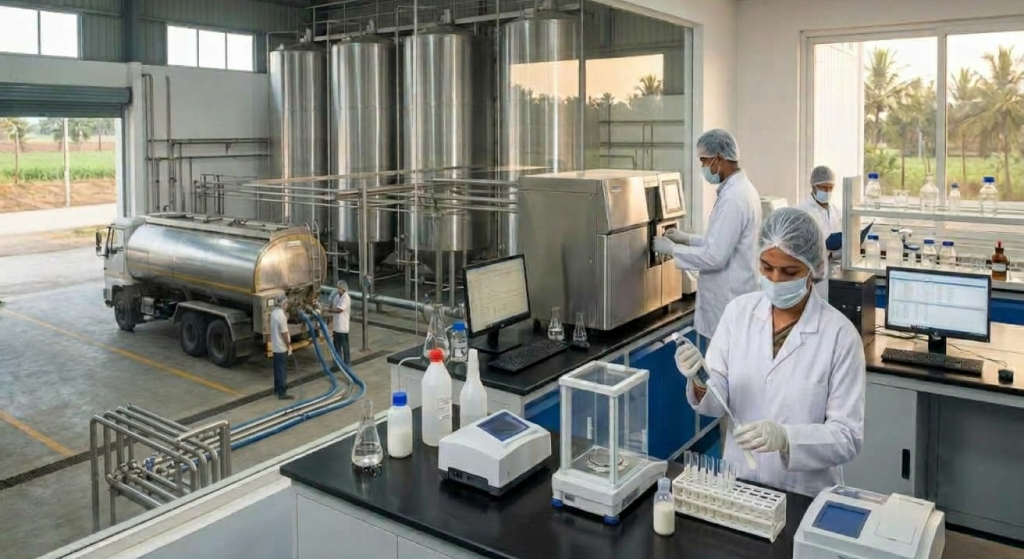
It is the week before Diwali. A Food Safety Officer walks into your plant holding a pouch of your ghee, bought from a shop forty kilometres away. He wants to know three things: which cream went into that batch, where the rest of the batch went, and what your lab found when it was tested. How long would your team need to answer?
That visit is not hypothetical this year. On 29 September 2026, FSSAI wrote to every state asking for a special festive drive on food safety, and named ghee, khoa and paneer among the products to be sampled. It follows a nationwide enforcement drive on milk, paneer and khoya that FSSAI ordered in December 2025.
This guide is for owners, plant heads and quality managers of dairies and milk unions in India. It covers what changed in FSSAI rules over the past year, the records your plant should be able to produce, and how to set up batch traceability that holds up when someone is standing at your gate.
We are Sanskar Technolab. We build dairy ERP software, so we work with these records every day, but we are not a law firm. The rules below were checked against FSSAI's own documents as they stood on 6 October 2026. Please confirm anything that affects your licence with your food safety consultant.
The short version
What changed in 2026

Your licence category is now based on turnover, not litres per day (from 1 April 2026).
Licences no longer expire. But miss the annual fee or the annual return and the licence is treated as suspended.
Milk producers outside cooperatives, and all milk vendors, have been told to register with FSSAI (11 March 2026).
Recalls are logged on FoSCoS, where they can be searched (from 18 March 2026).
A draft rule on paneer would stop non-milk products using the name. Comments close around 22 November 2026.
What has not changed
Each pack should have a batch number, there should be records of both the supplier and the customer, a written recall plan should be available, product testing should take place every six months, and an annual return must be submitted by 31 May.
What people get wrong
The FSSAI has not required the use of QR codes or software applications since the law only stresses the importance of maintaining proper records. What is important is how quickly those records can be prepared.
What changed for dairies in the past twelve months
Eight things happened between December 2025 and September 2026 that touch a dairy plant directly.
Date
What FSSAI did
What it means for your dairy
Date
16 Dec 2025
What FSSAI did
Directed all states to run a special enforcement drive on milk, paneer and khoya
What it means for your dairy
More sampling at plants and in the market, with states reporting every fortnight
Date
10 Mar 2026
What FSSAI did
Amended the licensing regulations. A licence now stays valid until it is suspended, cancelled or surrendered
What it means for your dairy
No more renewals. But an unpaid annual fee or a missed return suspends the licence, and you cannot operate while it is suspended
Date
11 Mar 2026
What FSSAI did
Advised milk producers outside cooperatives, and all milk vendors, to register
What it means for your dairy
If you buy directly from farmers or vendors, they need an FSSAI registration
Date
18 Mar 2026
What FSSAI did
Switched on a food recall module in FoSCoS
What it means for your dairy
Any recall you start must be logged there, and recall records can be searched
Date
1 Apr 2026
What FSSAI did
Brought in new turnover slabs for registration, State and Central licences
What it means for your dairy
Your category may have changed. Check it on FoSCoS
Date
23 Jun 2026
What FSSAI did
Amended the licence conditions and hygiene schedule
What it means for your dairy
Manufacturers must keep daily records of production and raw material use, and issue stock first-in-first-out or first-expiry-first-out
Date
23 Sep 2026
What FSSAI did
Published a draft rule reserving the word "paneer" for milk products
What it means for your dairy
Draft only. Open for comments for 60 days
Date
29 Sep 2026
What FSSAI did
Asked states for a special festive drive, naming milk products
What it means for your dairy
Inspections and sampling through Navratri and Diwali
Which FSSAI licence your dairy needs now
Until March 2026, a dairy's category was set by capacity. More than 50,000 litres a day meant a Central licence. FSSAI's current eligibility chart on FoSCoS classifies dairy units by annual turnover alone.
Annual turnover
What you need
Annual fee
Annual turnover
Up to ₹1.5 crore
What you need
Registration
Annual fee
₹100
Annual turnover
Above ₹1.5 crore, up to ₹50 crore
What you need
State licence
Annual fee
₹5,000
Annual turnover
Above ₹50 crore
What you need
Central licence
Annual fee
₹7,500
To put that in dairy terms: a plant selling about 28,000 litres a day at ₹50 a litre already crosses ₹50 crore a year. So some dairies that held a State licence under the old litre rule may now fall in the Central category. FSSAI has said existing licences migrate automatically on FoSCoS, with no new licence number.
Many websites still quote the old litre limits, so check your category on FoSCoS itself. If you run a small processing plant with a turnover below ₹1.5 crore, ask your licensing authority whether a registration is enough. The chart is not clear on that point.
Three things follow from your category.
The licence is permanent but conditional. Pay the annual fee and file the annual return on time. Miss either and the licence is treated as suspended until you clear it with the penalty.
Dairy is a high-risk category. Under FSSAI's risk-based inspection policy, high-risk businesses are inspected at least once a year. Central-licensed dairy manufacturers must also get a third-party food safety audit every year from an FSSAI-recognised agency.
Your suppliers may need a registration too. The March advisory exempts only a registered cooperative member who supplies or sells all their milk to the society. A private dairy buying directly from farmers or vendors should collect each supplier's FSSAI registration number and store it against their code. Registration costs a farmer ₹100 a year.
The compliance checklist
Print this section. Every item is a record or a practice that an inspector or auditor can ask for. The rule it comes from is noted beside it.
1. Licence and filings
A copy of the licence displayed at the plant. Licence condition 1
The 14-digit FSSAI number which appears on all invoices, bills and cash memos, having been in effect since 1 January 2022.
Annual fee paid on time.
Annual return in Form D-1 filed on FoSCoS by 31 May. Late filing costs ₹100 a day, capped at five times the annual licence fee, and it now suspends the licence as well.
You can stop looking for the half-yearly Form D-2. FSSAI dropped it for milk products from 2020-21, though many guides still list it.
2. People
One qualified technical person must be in charge of the production, this person having a degree in science, dairy technology or a comparable subject. Licence condition 4
A Food Safety Supervisor trained under FSSAI's FoSTaC programme for every 25 food handlers.
A medical examination of every food handler once a year, signed by a registered medical practitioner. Schedule 4
3. Raw milk reception
Raw milk cooled to 4°C or lower and held there until it is processed. Schedule 4, Part III
No mild steel or plastic cans for storing or carrying milk. Schedule 4, Part III
Reception test results recorded against each tanker. FSSAI's Scheme of Testing and Inspection for dairy plants covers adulterants, antibiotics and aflatoxin. Ask your consultant for the current test schedule.
Supplier details on file, including FSSAI registration numbers for farmers and vendors who are not cooperative members.
4. Processing and storage
Daily records of production and raw material use. Licence condition 8
The pasteurized milk was cooled immediately to 4°C or below and was kept at a temperature of no more than 5°C until it left the plant. Schedule 4, Part III
Storage temperatures recorded for chilled products. Schedule 4, Part III
A documented cleaning programme with records, including CIP. Schedule 4
Pest control records showing dates and chemicals used. Schedule 4
Stock issued first-in-first-out or first-expiry-first-out.
5. Testing
Each product tested for chemical and microbiological contaminants at least once in six months, in your own lab or an NABL-accredited or FSSAI-notified lab. Licence condition 12
Aflatoxin M1 in milk at no more than 0.5 micrograms per kg.
No residues of banned antimicrobials. Since 1 April 2025, a list that includes chloramphenicol, colistin and nitrofurans cannot be used at any stage of milk production.
Fat and SNF matching the class of milk printed on the pack. See the standards table.
6. Labelling
A batch, lot or code number on every pack. Labelling Regulations, 2020
An expiry or use-by date. For products with a shelf life of seven days or less, such as pouch milk, the date of manufacture may be left out. The use-by date may not.
The class of milk and the heat treatment declared on the pack.
No "100%" claims on packs or in advertising, as in "100% pure ghee". FSSAI advised on this issue in May 2025.
If a non-milk ingredient replaces any milk constituent, the product is an analogue. The label must say what it contains and which milk constituent it does not.
7. Traceability and recall
A written, up-to-date recall plan. Mandatory for manufacturers and wholesalers. Recall Regulations, 2017
Records of suppliers and customers: names, addresses, product, purchase and delivery dates, batch code, pack size, manufacture and expiry dates.
Those records kept for one year after the expiry date.
Any recall you start logged on FoSCoS.
8. Audits and record keeping
A periodic internal audit of your hygiene and food safety system. Schedule 4
A third-party audit every year, if you are a Central-licensed manufacturer.
Production, storage, distribution, quality, lab, cleaning, pest control and recall records kept for one year or the product's shelf life, whichever is longer. Schedule 4
Keeping these in registers and Excel?
See how Sanskar Dair ERP holds batch, quality, gate and supplier records in one system.
FSSAI standards for liquid milk
These are the all-India minimums. The older state-wise figures for cow and buffalo milk were replaced by uniform standards in 2018, though some guides online still quote them.
Class of milk
Milk fat, minimum
SNF, minimum
Class of milk
Buffalo milk
Milk fat, minimum
5.0%
SNF, minimum
9.0%
Class of milk
Cow milk
Milk fat, minimum
3.2%
SNF, minimum
8.3%
Class of milk
Mixed milk
Milk fat, minimum
4.5%
SNF, minimum
8.5%
Class of milk
Full cream milk
Milk fat, minimum
6.0%
SNF, minimum
9.0%
Class of milk
Standardised milk
Milk fat, minimum
4.5%
SNF, minimum
8.5%
Class of milk
Toned milk
Milk fat, minimum
3.0%
SNF, minimum
8.5%
Class of milk
Double toned milk
Milk fat, minimum
1.5%
SNF, minimum
9.0%
Class of milk
Skimmed milk
Milk fat, minimum
Not more than 0.5%
SNF, minimum
8.7%
The paneer draft, and what to do about it
The draft published in the Gazette on 23 September 2026 would add "paneer made of constituents not derived from milk" to the list of products that cannot be sold. Products already licensed in the analogue category would have to drop the word paneer from their names, labels and marketing.
It is a draft. It has no start date and no transition period yet, and FSSAI is taking comments for 60 days, which runs to about 22 November 2026. Several states have not waited. Chhattisgarh, Maharashtra, Karnataka and Telangana have issued their own bans on analogue paneer, and Gujarat has acted against unstandardised analogue paneer, cheese and butter.
What to do now:
If you make only milk paneer, nothing changes in your plant. Make sure your label and your lab reports can prove it is milk paneer.
If you make or trade an analogue product, review every name, label, price list and distributor scheme that uses the word paneer, and check the position in each state you sell in.
If you have a view, send it. Comments go to FSSAI at regulation@fssai.gov.in.
Batch traceability: what the law asks
The duties sit in the Food Recall Procedure Regulations, 2017. A manufacturer must:
keep an up-to-date recall plan;
keep supplier and customer records by batch, for one year after expiry;
inform FSSAI immediately, and within 24 hours, once it knows a product needs to be recalled;
send a status report every week while the recall runs, and a follow-up report within 30 days of finishing;
log the recall on FoSCoS, since March 2026.
None of this mentions QR codes, blockchain or any software. You can meet every one of these duties on paper. The difficulty in a dairy is not the rule. It is the milk.
Why traceability is harder in a dairy
A biscuit factory receives flour in bags with lot numbers. You receive milk from hundreds of societies, pooled in tankers, pooled again in silos, split into several products and packed through the night. To trace one pouch you need five links, and each one has to be written down at the time.
1
Tanker lot.
Every tanker receipt gets a number tied to its route, its societies or farmers, the shift, the quantity and the reception test results.
2
Silo lot.
Record which tankers went into which silo. Treat the milk between two cleanings of that silo as one lot.
3
Process batch.
Each pasteuriser or standardisation run notes the silo it drew from and the time it ran.
4
Packing batch.
Each product packed on one line in one time window gets the code that is printed on the pack.
5
Dispatch.
Each batch code is recorded against the route, vehicle and customer that received it.
Break any one link and you can no longer narrow the problem. You end up recalling a full day's production when one batch would have done.
Illustration
A complaint comes in on toned milk, batch T2. Your records show T2 was 18,000 litres, packed between 9 pm and 11 pm into 36,000 half-litre pouches from Silo 3. Silo 3 held four tankers from routes 7, 12, 15 and 21 after its last cleaning. The batch left on nine vehicles to 42 distributors.
With all five links, you recall 36,000 pouches and you know which four routes to test. With the silo link missing, you are recalling the whole night's packing and you cannot tell the officer where the milk came from.
Cream, butter and ghee stretch a lot across days
Cream separated today may be churned tomorrow and boiled into ghee next week, together with cream from five other days. Record which cream lots went into each churn and each ghee batch. Without that, one doubtful tanker can spread across a month of ghee. Reprocessed milk and rework need the same care.
How fast is fast enough?
The regulation gives you 24 hours to inform FSSAI. FSSAI's guidance document for dairy processing, which is voluntary, suggests that you should be able to trace a lot within 24 hours and test your recall procedure at least once a year. Plants certified to the BRCGS standard work to four hours.
We suggest four hours as your target. If the product is pouch milk, most of it is consumed within a day, so a trace that takes until tomorrow is too late to matter.
Run a mock recall this month
You will learn more from one drill than from any audit report. It takes half a day.
1
Pick a real batch.
Take the code from a pack dispatched last week. Do not warn the team.
2
Start a clock.
3
Trace back.
Packing record, process batch, silo, tankers, routes and the reception tests for each tanker.
4
Trace forward.
Every route, vehicle and customer that received the batch, with quantities.
5
Reconcile the quantity.
What was packed should equal what was dispatched, plus what is in cold store, plus returns, leakage and lab samples. Aim to account for all of it.
6
Pull the supporting records.
Pasteurisation, cleaning before the run, lab results for the batch, cold store temperatures.
7
Stop the clock.
Note the time taken, what was missing and who had to be phoned. Fix the weakest link and repeat in three months.
If it took a day and three registers, you have found your gap, and you found it before an inspector did.
See a batch traced live.
On a demo we take one batch code, trace it back to the tankers and forward to the distributors while you watch.
What non-compliance costs
Offence
Maximum
Offence
Running a food business without a licence (section 63)
Maximum
Penalty up to ₹10 lakh
Offence
Sub-standard food (section 51)
Maximum
Penalty up to ₹5 lakh
Offence
Misbranded food (section 52)
Maximum
Penalty up to ₹3 lakh
Offence
Not following a Food Safety Officer's direction (section 55)
Maximum
Penalty up to ₹2 lakh
Offence
Unsafe food (section 59)
Maximum
From three months and ₹3 lakh where nobody is harmed, up to life imprisonment and a fine of at least ₹10 lakh where it causes death
The fines are not the main cost. In 2024-25, enforcement authorities analysed 33,405 samples of milk and milk products and found 12,780 of them non-conforming. They launched 12,057 cases. Those are enforcement samples, taken where officers already suspect a problem, so they do not describe all the milk in the country. They do show how closely dairy is being watched.
And since March 2026 a recall is a public record on FoSCoS. For a brand that sells on trust, that is the bigger penalty.
Choosing software to manage all this?
Our buyer's guide compares the five kinds of system Indian dairies use, with costs.
Where software helps, and where it does not
Software does not make milk safe. Chilling, cleaning and testing do that. What a system changes is retrieval: whether the five links are captured as the work happens, and whether you can pull them together in minutes when someone asks.
In Sanskar Dair ERP, our dairy ERP built on ERPNext, the records in this guide sit in these places:
Procurement: collection data from AMCS, traceable from the collection point to the plant, with supplier registration and compliance records.
Gate: inward tanker verification and quantity logging, outward dispatch verification, and searchable audit logs.
Plant: quality inspection logs at reception, production batch tracking and yield.
Stores: batch-wise and lot-wise stock across the plant, BMCs and chilling centres, with expiry tracking and cold storage temperature monitoring.
Dispatch: each invoice and delivery tied to the batch, route and customer.
It does not file your annual return on FoSCoS, replace your lab or write your recall plan. Those stay with your quality team. If you are still deciding what kind of system you need, our buyer's guide to dairy ERP in India sets out the options.
Frequently asked questions
Which FSSAI licence does a dairy plant need in 2026?
Since 1 April 2026 the category depends on annual turnover. Up to ₹1.5 crore needs a registration, above ₹1.5 crore and up to ₹50 crore a State licence, and above ₹50 crore a Central licence. The earlier litres-per-day limits no longer appear in FSSAI's eligibility chart, so confirm your category on FoSCoS.
Do dairy farmers need FSSAI registration?
FSSAI's advisory of 11 March 2026 asks all milk producers and milk vendors to register. The only exemption is for a registered member of a dairy cooperative society who supplies or sells all their milk to that society.
Is batch traceability mandatory for dairy products in India?
Yes, in effect. Every pack must carry a batch or lot number, and the Food Recall Procedure Regulations, 2017 require manufacturers to keep supplier and customer records by batch and to hold a written recall plan. No rule requires QR codes or any particular software.
How long must a dairy keep its records?
Distribution records under the recall regulations must be kept for one year after the expiry or best-before date. Production, quality, lab, cleaning, pest control and recall records must be kept for one year or the product's shelf life, whichever is longer.
How quickly must a food recall be reported to FSSAI?
Immediately, and within 24 hours of the business learning that a product needs to be recalled. Status reports follow every week, and a follow-up report is due within 30 days of completing the recall. Since 18 March 2026, recalls are logged on FoSCoS.
What is the FSSAI rule on analogue paneer?
FSSAI published a draft on 23 September 2026 that would bar products made from non-milk constituents from being sold as paneer, and would make existing analogue products drop the word from their names, labels and marketing. It is a draft, open for comments for 60 days. Several states have already issued their own bans.
Is the half-yearly return in Form D-2 still required for milk products?
No. FSSAI discontinued the half-yearly Form D-2 for milk and milk product manufacturers from 2020-21. The annual return in Form D-1 is still due by 31 May each year on FoSCoS.
What are the FSSAI standards for toned milk?
Toned milk must have at least 3.0% milk fat and 8.5% solids-not-fat. Double toned milk needs at least 1.5% fat and 9.0% SNF, standardised milk 4.5% and 8.5%, and full cream milk 6.0% and 9.0%.
Find your gaps before an inspector does
Bring one batch code and the registers you use today. We will show you how the same records look in a dairy ERP, and where plants usually find their weak link.
Author

Anand Thakker is the Founder and CEO of Sanskar Technolab, an Ahmedabad-based ERPNext implementation partner with 100+ implementations across dairy, distribution, EPC and financial services.
Share


Sources
- FSSAI advisory of 11 March 2026 on milk producers and milk vendors
- Food Safety and Standards (Licensing and Registration of Food Businesses) Amendment Regulations, 2026, Gazette of India, 10 March 2026
- FSSAI order of 13 March 2026 on revised turnover thresholds
- FoSCoS kind-of-business eligibility chart, updated April 2026
- FSSAI order of 18 March 2026 on the food recall module in FoSCoS
- Licensing and Registration (Second Amendment) Regulations, 2026, Gazette of India, June 2026
- Draft Prohibition and Restrictions on Sales Amendment Regulations, 2026 (paneer)
- FSSAI letter of 29 September 2026 on the special festive drive
- FSSAI compendium of the Licensing and Registration Regulations, 2011 (Schedule 4 and conditions of licence)
- FSSAI frequently asked questions on food recall, revised May 2024 (Food Recall Procedure Regulations, 2017)
- FSSAI compendium of the Labelling and Display Regulations, 2020
- Food Products Standards Regulations, Chapter 2.1: dairy products and analogues
- FSSAI guidance document for milk and milk products (voluntary)
- FSSAI licensing FAQ, December 2021 (Form D-2 discontinued)
- FSSAI press release on "100%" claims, May 2025
- Food Safety and Standards Act, 2006, sections 51, 52, 55, 59 and 63, as amended by the Jan Vishwas Act, 2023
- IANS: Lok Sabha reply on milk product samples, 13 February 2026
- ANI: FSSAI enforcement drive on milk products, December 2025
- Down To Earth: antimicrobials prohibited in milk production from April 2025
- The South First and Down To Earth: state action on analogue paneer
Related post
Dairy
Best ERP for the Dairy Industry in India: 2026 Buyer's Guide
What Indian dairies actually buy, what each option costs, and twelve questions that tell a real dairy ERP apart from a general ERP with a dairy brochure.


20th August, 2026

12 min read

Dairy
From Farm to Shelf: How AI-Integrated ERP Solutions are Revolutionizing Dairy Operations and Supply Chain Efficiency
The dairy industry is one of the most operationally complex sectors in the food and agriculture value chain
25th March, 2026
3 min read

ERPNext
What Business Leaders Learned from Frappe Yatra Ahmedabad 2026
See how ERPNext, open source software, and automation help businesses standardize processes and improve decision-making.

2nd June, 2026
6 min read


