Are You the Owner of Your Code — or Just a Tenant?
Transforming ERP from a rented dependency into an owned national asset — the future of digital control, cost, and continuity.

A Strategic Wake-Up Call for Indian Enterprises Choosing Their Next ERP
In today's hyper-connected world, digital infrastructure has become the backbone of every enterprise. But here's the uncomfortable truth:
If you don't own your software's code, you don't own your business.
Recent global incidents — from defence aviation to energy, telecom, and even social media — have shown how reliance on proprietary software can instantly disrupt national systems, enterprise operations, and business continuity.
Why Code Ownership Decides Your Enterprise's Future
Imagine waking up one morning to find your ERP access suspended.

This is not fiction.
#1
Dassault & the Rafale Code Lock (2025)
RAFALE SOURCE CODE WHY FRANCE SAYS NO TO INDIA

India sought access to source code to integrate the Astra missile system with Rafale jets. Dassault refused.
Result? India bought the jet — but not its brain.
It proved one thing clearly:
When you don't own the code, you don't own the capability.
#2
Nayara Energy & Microsoft (2025)
Microsoft Blocks access, Nayara moves HC
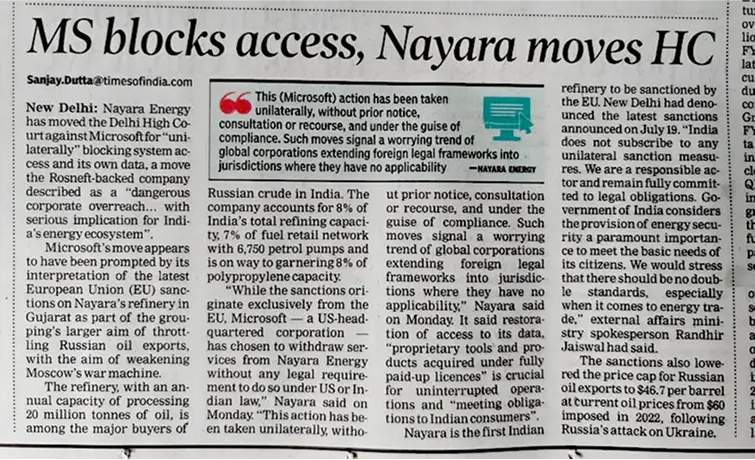
Microsoft temporarily suspended ERP access for Nayara Energy due to global sanctions.A single policy decision froze one of India's largest oil refiners.
The message?
A foreign license is not ownership — it is permission. And permission can be withdrawn.
These events reveal a pattern:
If your business depends on software that you do not control — the company that owns that software (the vendor) can affect your business anytime.
So…
- If the vendor stops support → your business suffers.
- If the vendor changes pricing → your business must pay.
- If the vendor blocks access → your operations freeze.
- If the vendor faces political, legal, or financial issues → your business gets affected even if you did nothing wrong.
In short:
Your business becomes vulnerable because someone else controls the technology you depend on.
It's like renting your factory building — if the landlord locks the door, your production stops.
When Global Vendors Hold the Keys to Your Business
The risks extend beyond India.
Global cases show how vendor policies can cripple entire ecosystems:
#1
Huawei & Google (2019 onwards)
Google revoked Android services millions of devices disrupted.
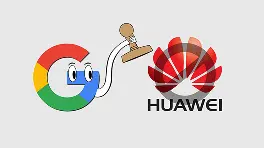
When the U.S. government added Huawei to its Entity List, Google revoked certain Android services for new Huawei devices. The result: access to Play Store and Google mobile services was restricted, creating a sudden functional gap for millions of users and forcing
Huawei to accelerate its alternative OS and app ecosystem. This is a vendor-access problem writ large: when a core platform provider withdraws services, device ecosystems and their users scramble.
#2
Parler Deplatforming (2021)
Removed from hosting and app stores offline overnight.

In 2021, the social platform Parler was effectively deplatformed — removed from app stores and hosting — after major cloud and platform providers took action following content moderation concerns. For a platform that lacked independent hosting and backup strategies, sudden deplatforming meant loss of reach, data access and business continuity. This case shows how dependency on third-party infrastructure can become an existential risk.
Looking for a partner who can help you move away from vendor-dependent systems?
Talk to our team of certified experts.ERP as an Asset: Not a Rental Liability
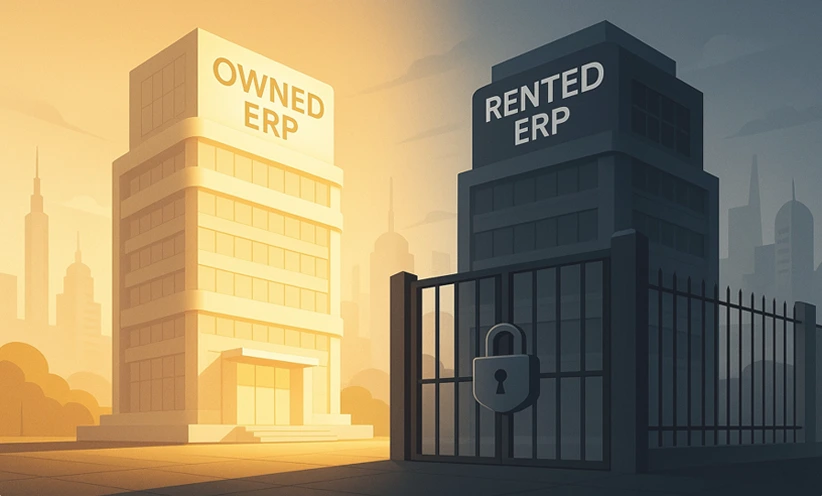
Think of ERP like real estate:
ERPNext = Owning a Home

You have the keys.
You can extend, redesign, renovate, customize.
It's yours — permanently.
SAP, Oracle, MS Dynamics = Renting an Apartment
Stop paying → access blocked.
Vendor rules → not your rules.
Your business runs on someone else's property.
In the era of digital sovereignty, owning your ERP is owning your future.
ERPNext: India's Digital Independence Framework
ERPNext, built in Mumbai by Frappe Technologies, is more than an ERP.It's a national movement toward technological freedom.
Why ERPNext is a sovereignty-first ERP:
Data Sovereignty: Host on your own servers or Indian clouds. Your data, your control.
100% Open Source: Full source-code access
Zero Lock-In: Modify, customize, extend — freely
Unlimited Customization: Built on the flexible Frappe framework
No Licensing Fees: GPL license, no per-user trap
Local Ecosystem: India-led partner network
Atmanirbhar Bharat Support: Fully aligned with India's innovation goals
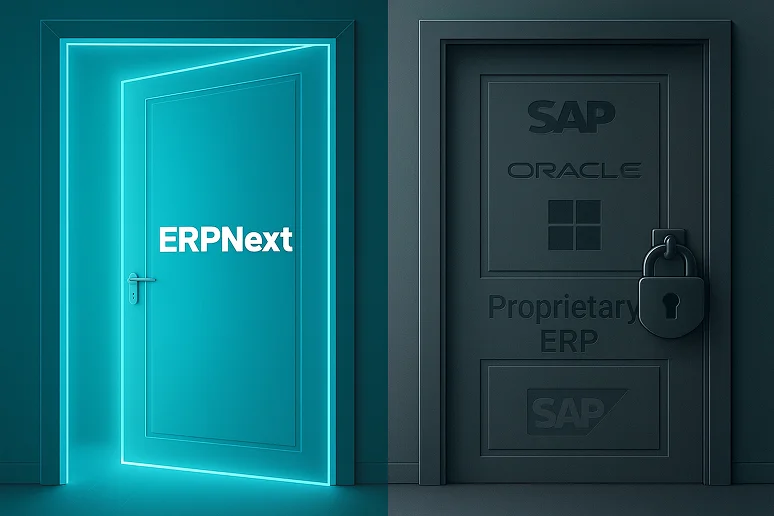
In other words: Open-source ERP means independence; proprietary means permission.
ERPNext vs SAP vs Microsoft Dynamics — A Clear Comparison
License Model
ERPNext 100% Free (GPL)
No per-user fees
SAP ERP Proprietary
Licensing & maintenance
Microsoft Dynamics Proprietary
Subscription & cloud fees
Source Code Access
ERPNext Full access
Modifiable
SAP ERP Closed
Vendor controlled
Microsoft Dynamics Closed
Ecosystem bound
Vendor Lock-In
ERPNext None
You own the code
SAP ERP High
Vendor controls upgrades
Microsoft Dynamics High
Tied to Azure & partners
Customization
ERPNext Unlimited on Frappe framework
SAP ERP Possible but complex
(vendor/ABAP)
Microsoft Dynamics Possible via partners
Data Control
ERPNext Self-host / India cloud
SAP ERP Often vendor cloud / global DCs
Microsoft Dynamics Azure global
Indian Support
ERPNext Yes
Frappe & local partners
SAP ERP Global consultants,
local offices
Microsoft Dynamics Partner network,
Microsoft India
Atmanirbhar Fit
ERPNext 100% Indian
SAP ERP Foreign vendor
Microsoft Dynamics Foreign vendor
This comparison clearly shows:

ERPNext doesn't just run your business — it belongs to your business.
Need help evaluating ERPNext for your company?
Work with certified experts who understand SAP, Oracle, and ERPNext migrations.
Why Indian Enterprises Are Choosing ERPNext
India's digital landscape is shifting:
from dependency → to sovereignty.
from licensing → to ownership.
from rent → to build.
Top reasons CEOs and CIOs prefer ERPNext:
Full ownership of ERP and data
No dependency on foreign vendors
Massive cost savings vs SAP/Oracle
Customizable for Indian compliance
Strong local implementation ecosystem
Ideal for manufacturing, EPC, retail, finance, healthcare, NBFCs
ERPNext isn't just an ERP choice.
It's a strategic national alignment.
Executive Takeaway
Own Your Software. Own Your Future.
The global landscape makes one fact undeniable:
Code is the new currency of power.
And code ownership determines survival.
ERPNext empowers Indian enterprises to build digital systems they control — not systems controlled by distant vendors and licensing walls.
If you want long-term security, flexibility, resilience, and sovereignty…
ERPNext is the future.
Ready to move from rented software to owned digital infrastructure
Let’s build your ERP freedom journey together.
Author

Krish is an ERPNext Consultant who specializes in building efficient, customized business systems. He's known for turning complex processes into simple, automated, and scalable solutions.
Share


Related post
ERPNext
What Business Leaders Learned from Frappe Yatra Ahmedabad 2026
See how ERPNext, open source software, and automation help businesses standardize processes and improve decision-making.


2nd June, 2026

6 min read

ERPNext
The Real Cost of ERPNext Implementation in 2026
A Strategic Executive Briefing on TCO, ROI, and Operational Scalability

16th April, 2026
5 min read

ERPNext
ERPNext v16 Accounting: A CFO's: Upgrade Finance Book
A Strategic Deep Dive into Financial Control, Closing Efficiency, and Governance in ERPNext v16
17th February, 2026
5 min read


